Top 13 Animals Starting With X That Will Surprise You
Have you ever tried to think of an animal that starts with the letter “X”? In this article, we’ll explore the top 13 animals starting with X and discover why they’re so interesting. You’ll learn cool facts about these x animals and why they matter in the animal kingdom.
List of Animals Starting With X
Here is the list of the top 13 Animals starting with x.
- X-Ray Tetra
- Xenoposeidon
- Xeme (Sabine’s Gull)
- Xingu River Ray
- Xenacanthus
- Xenoceratops
- Xenotarsosaurus
- Xoloitzcuintli
- Xerus
- Xiaosaurus
- Xiaotingia
- Xiongguanlong
- Xiphactinus
X-Ray Tetra
KINGDOM: Animalia
PHYLUM: Chordata
CLASS: Actinopterygii
ORDER: Characiformes
FAMILY: Characidae
GENUS: Pristella
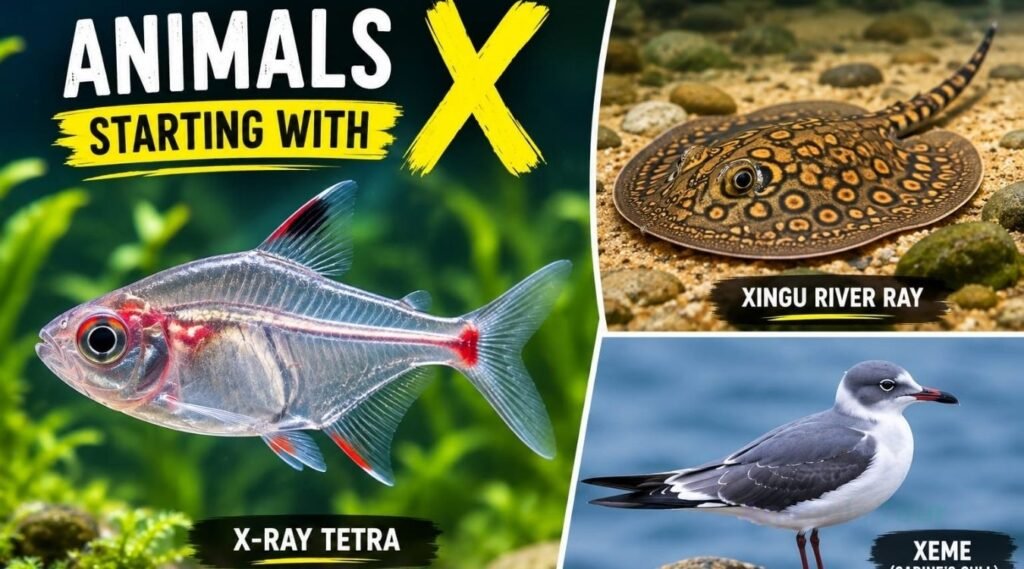
The X-Ray Tetra is a fascinating fish known for its clear, translucent body that resembles a living x-ray, hence the name. Originating from the rivers of South America, especially in Brazil, these small fish can thrive in schools, making them lively additions to home aquariums. Growing up to about 1.5 inches long, they are peaceful and adapt well to various water conditions, which makes them perfect for beginner aquarists.
An interesting fact about X-Ray Tetras is their unique ability to communicate with each other through subtle body movements and changes in color. These fish are omnivores, which means they eat both plants and small insects. By keeping them in a well-planted tank with gentle filters, you can mimic their natural habitat and watch them flourish. If you’re looking for animals that start with “x,” the X-Ray Tetra is not just visually stunning; it also showcases a vibrant ecosystem in miniature form!
Xenoposeidon
– Kingdom: Animalia
– Phylum: Chordata
– Class: Sauropoda
– Order: Saurischia
– Family: Titanosauridae
– Genus: Xenoposeidon
Xenoposeidon is a fascinating dinosaur that roamed the Earth over 120 million years ago during the Early Cretaceous period. This massive creature was a type of sauropod, known for its long neck and towering stature. Scientists believe it could have reached lengths of up to 60 feet, making it one of the largest dinosaurs ever discovered.
Interestingly, Xenoposeidon’s fossils were found in England, giving researchers important clues about the diverse ecosystems of that era. Unlike many dinosaurs, this giant is not well-known, with only a few bones available for study, leading to ongoing debates about its exact classification.
One of the unique features of Xenoposeidon is its long, whip-like tail, which may have been used for communication or defense against predators. Its large, herbivorous diet likely included a variety of plants that thrived during the Cretaceous, helping it grow to such immense sizes.
Fossils like these help scientists piece together the picture of how x animals, specifically dinosaurs, lived and interacted within their environments. Although Xenoposeidon may not be as famous as other dinosaurs, it certainly adds depth to our understanding of the diversity of life on Earth millions of years ago.
Xeme (Sabine’s Gull)
– KINGDOM: Animalia
– PHYLUM: Chordata
– CLASS: Aves
– ORDER: Charadriiformes
– FAMILY: Laridae
– GENUS: Xema
The Xeme, commonly known as Sabine’s Gull, is a migratory bird famous for its striking appearance. This bird is distinct with its slender body and long wings, displaying a beautiful blend of gray and white feathers. During the breeding season, you can spot them in Arctic regions, where they create nests on the ground. When winter comes, they fly south to coastal areas, often seen gliding gracefully over the ocean.
One interesting fact about the Xeme is its unique hunting technique. It catches small fish and insects by diving from above while also scavenging for food during migration. Their diverse diet helps them thrive in different environments, making them adaptable animals.
Xingu River Ray
– Kingdom: Animalia
– Phylum: Chordata
– Class: Chondrichthyes
– Order: Myliobatiformes
– Family: Potamotrygonidae
– Genus: Potamotrygon
The Xingu River Ray is a unique species of freshwater stingray found in the Amazon River basin, particularly in Brazil’s Xingu River. Unlike marine rays, these rays have adapted to live in rivers, showcasing a range of beautiful colors and patterns on their flat, disc-shaped bodies.
They use their wide, paddle-like fins to glide gracefully through the water, searching for small fish and crustaceans to eat. Their ability to blend into the riverbed helps them avoid predators while hunting for food.
Xingu River Rays play a vital role in their ecosystem, helping to maintain the balance of the river’s food web. Due to habitat destruction and pollution in their native rivers, these rays face significant threats.
Xenacanthus
– KINGDOM: Animalia
– PHYLUM: Chordata
– CLASS: Chondrichthyes
– ORDER: Xenacanthiformes
– FAMILY: Xenacanthidae
– GENUS: Xenacanthus
Xenacanthus was a distinct type of prehistoric fish that roamed the waters over 300 million years ago. These fish are known for their long, eel-like bodies and unusual appearance, which included a prominent dorsal fin that ran along their back. Unlike most fish today, Xenacanthus belonged to a group called cartilaginous fish, meaning their skeletons were made of cartilage instead of bone, similar to sharks and rays.
This ancient fish lived during the Carboniferous period, primarily in freshwater environments. It was believed that Xenacanthus was a predator, using its sharp teeth to catch smaller fish and other aquatic creatures. The unique structure of its body and fins allowed it to navigate through various underwater habitats, giving it an edge in survival during its time.
Xenoceratops
– Kingdom: Animalia
– Phylum: Chordata
– Class: Reptilia
– Order: Ornithischia
– Family: Ceratopsidae
– Genus: Xenoceratops
Xenoceratops was a horned dinosaur that lived around 78 million years ago during the Late Cretaceous period in what is now Canada. One of its standout features was its large bony frill and unique facial horns, which likely helped in social behaviors and possibly defense against predators. Scientists believe this dinosaur was herbivorous, using its beak-like mouth to munch on tough plant material.
Unlike other ceratopsids, Xenoceratops had a distinct skull structure, which allows researchers to learn more about the diversity of dinosaurs in its family. Its fossils provide insights into how these creatures adapted to their environment and their social interactions. By studying Xenoceratops, scientists hope to uncover more about the ecosystem it lived in and how these dinosaurs survived millions of years ago.
Xenotarsosaurus
Kingdom: Animalia
Phylum: Chordata
Class: Reptilia
Order: Saurischia
Family: Unknown
Genus: Xenotarsosaurus
Xenotarsosaurus is one of the rare animals starting with “X.” It lived during the Late Triassic period, about 230 million years ago. This dinosaur belonged to the group of reptiles known as Saurischia, which means “lizard-hipped.” Unlike many other dinosaurs, not much is known about its physical traits or behaviors, making it a bit of a mystery to scientists.
What makes Xenotarsosaurus interesting is that it gives us a glimpse into the past when dinosaurs roamed the Earth. Its fossils help researchers understand how these creatures evolved over time. While we don’t have a complete picture of this dinosaur, studying it adds pieces to the puzzle of how life has changed throughout millions of years. Animals like Xenotarsosaurus remind us that there are still many secrets left to discover in the world of prehistoric creatures.
Xoloitzcuintli
– Kingdom: Animalia
– Phylum: Chordata
– Class: Mammalia
– Order: Carnivora
– Family: Canidae
– Genus: Xoloitzcuintli
The Xoloitzcuintli, or Xolo for short, is a unique dog breed from Mexico. These dogs are one of the oldest in the world, dating back over 3,000 years. They come in three sizes — toy, miniature, and standard — making them great companions for different households. What sets the Xolo apart is its hairless skin, which can be a blend of colors like black, gray, and red. Their lack of fur means they require special care for their skin, which can be sensitive to sun exposure.
Apart from their unusual appearance, Xolos are known for their loyalty and calm demeanor. They often form strong bonds with their owners, making them loving pets. These dogs also have a history deeply tied to Aztec culture, where they were believed to have magical properties. In a world where it’s easy to overlook lesser-known breeds, the Xoloitzcuintli stands out as a testament to heritage, character, and companionship in the realm of animals starting with x.
Xerus
– Kingdom: Animalia
– Phylum: Chordata
– Class: Mammalia
– Order: Rodentia
– Family: Sciuridae
– Genus: Xerus
Xerus, commonly known as African ground squirrels, are small mammals that live in parts of Africa. They often inhabit open areas like savannas and grasslands, where they can easily spot predators. Unlike tree squirrels, these ground squirrels prefer to stay on the ground, digging burrows to escape the heat and to store food. Their social behavior stands out; they often live in groups and communicate through various sounds to warn each other of danger.
When it comes to their diet, Xerus mainly munch on seeds, nuts, and other plant parts. This diet is essential for their survival, especially since they must store food for times when resources are scarce. They have cheek pouches that help them carry food back to their burrows. Their adaptation to life on the ground allows them to thrive in their environment, making them an important part of the ecosystem.
Xiaosaurus
– Kingdom: Animalia
– Phylum: Chordata
– Class: Reptilia
– Order: Ornithischia
– Family: Xiaosauridae
– Genus: Xiaosaurus
Xiaosaurus was a small herbivorous dinosaur that roamed the Earth during the Late Jurassic period, roughly 160 million years ago. This dinosaur was about the size of a dog, making it one of the smaller members of its family. Xiaosaurus had a unique feature: a beak-like mouth that helped it munch on plants. It likely lived in forests where it could find plenty of leaves to eat. Its fossils have primarily been discovered in what is now China, providing clues about its environment and lifestyle.
Unlike many larger dinosaurs that focused on speed and strength, Xiaosaurus adapted to a different survival strategy. Its smaller size meant it had to be clever and cautious, often hiding from larger predators in the dense vegetation. Being a herbivore, it played an essential role in its ecosystem by helping to disperse plant seeds. This behavior likely contributed to the health of the environment around it, showing how even small creatures can have a big impact.
Fossil evidence suggests that Xiaosaurus was social, as it may have traveled in groups to find food more efficiently. This behavior helped provide safety in numbers against larger predators. The dinosaur’s discovery has led scientists to learn more about the diverse types of dinosaurs that existed during its time and how they interacted with one another and their surroundings.
Xiaotingia
– Kingdom: Animalia
– Phylum: Chordata
– Class: Aves
– Order: Pterosauria
– Family: Dromaeosauridae
– Genus: Xiaotingia
Xiaotingia represents an ancient type of bird-like dinosaur that lived millions of years ago. These creatures were part of the broader family of dromaeosaurids, which are known for their agility and unique hunting styles. Xiaotingia was small but poised, showcasing features that hint at a lifestyle that included both running and climbing. Its adaptations suggest it might have used its sharp claws to catch prey and climb trees, similar to how some modern birds and reptiles behave today.
In terms of appearance, Xiaotingia likely had feathers. These feathers would have provided insulation as well as the potential for gliding. The structure of its bones points to a lightweight build, allowing it to maneuver through its environment efficiently. This creature’s digs in present-day China have provided invaluable information about the transition from dinosaurs to birds, offering insights into how certain traits evolved over time.
Xiongguanlong
– Kingdom: Animalia
– Phylum: Chordata
– Class: Reptilia
– Order: Saurischia
– Family: Theropoda
– Genus: Xiongguanlong
Xiongguanlong is a type of dinosaur that lived in what is now China around 120 million years ago. It belonged to the theropod family, which makes it a relative of modern birds. With a long neck and sharp teeth, it was likely an agile predator in its environment.
Scientists believe it was about 20 feet long, using its size to hunt for smaller dinosaurs and other animals. What makes Xiongguanlong interesting is its unique blend of features that show it was an early member of larger theropods. Studying its fossils helps paleontologists understand how dinosaurs evolved over millions of years.
Xiphactinus
– Kingdom: Animalia
– Phylum: Chordata
– Class: Actinopterygii
– Order: Istiophoriformes
– Family: Xiphiidae
– Genus: Xiphactinus
Xiphactinus was a large prehistoric fish that lived around 70 million years ago. It could grow up to 20 feet long and was known for its sharp teeth and strong jaw. This animal that starts with x, swam in the seas during the time of the dinosaurs and was a fierce predator, often hunting smaller fish and even other Xiphactinus. Its long, streamlined body helped it move quickly through the water, making it an efficient hunter.
It represents a group of fish that thrived during a time when the oceans were full of life. Fossils show that it had a robust skeleton and powerful fins, which allowed it to be agile.Its remains, often found in North America, tell a story of survival and adaptation in a changing world.
Conclusion
Animals starting with X are quite rare, but they are truly fascinating. From the X-ray fish to the Xerus, each of these creatures adds to the incredible diversity of life on our planet. Learning about these unique animals helps us appreciate nature even more.
FAQs
What are some examples of animals starting with X?
Some examples include the Xerus, X-ray fish, and Xenomorph.
Why are there so few animals that start with the letter X?
The letter X is less common in many languages, resulting in fewer animal names.
Is the X-ray fish unique in any way?
Yes, the X-ray fish has transparent bodies, allowing you to see its internal organs.
What is a Xerus?
A Xerus is an African ground squirrel known for its social behavior and burrowing habits.