Top 12 Smartest Insects in the World (with images)
Tiny in size but impressive in ability, some insects display intelligence that surprises even scientists. The smartest insects can communicate, solve problems, remember locations, work together, and adapt to changing environments with remarkable efficiency.
From bees that learn patterns to ants that build highly organized colonies, these insects prove that intelligence is not limited to large animals. In this article, we will explore the top 12 smartest insects in the world and discover the unique abilities that make them stand out in the natural world.
List of the top 12 Smartest Insects in the World
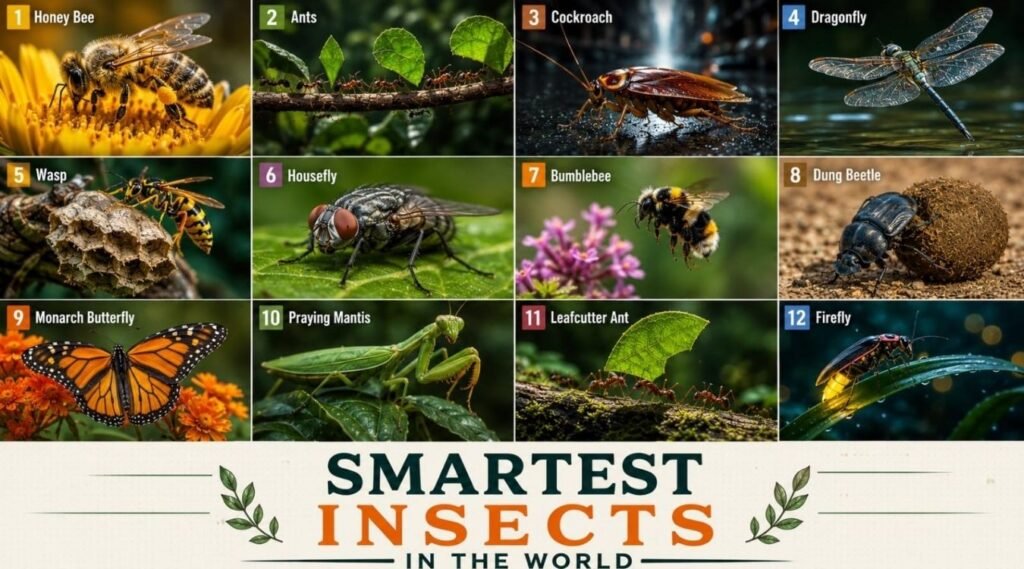
Here is the list of the smartest insects in the world that will be discussed in detail with images.
- Honey Bee
- Ant
- Cockroach
- Dragonfly
- Wasp
- Housefly
- Bumblebee
- Dung Beetle
- Monarch Butterfly
- Praying Mantis
- Leafcutter Ant
- Firefly
Honey Bee-Master of Communication and Teamwork
Scientific Name: Apis mellifera
Diet: Nectar and pollen from flowers
Honey bees live in highly organized colonies that can contain up to 80,000 individuals, with each bee performing a specific role. Worker bees collect nectar and pollen, guard bees defend the hive, and the queen’s main role is laying eggs. Their ability to cooperate and share information is one reason honey bees are considered among the smartest insects in the world.
When a honey bee finds a good food source, it returns to the hive and performs a movement called the waggle dance. The direction of the dance tells other bees where to fly, while the length of the dance shows how far away the food is. Honey bees use the position of the sun as a reference point, creating one of the most advanced communication systems in the insect world. Studies have also shown that honey bees can count and understand the concept of zero.
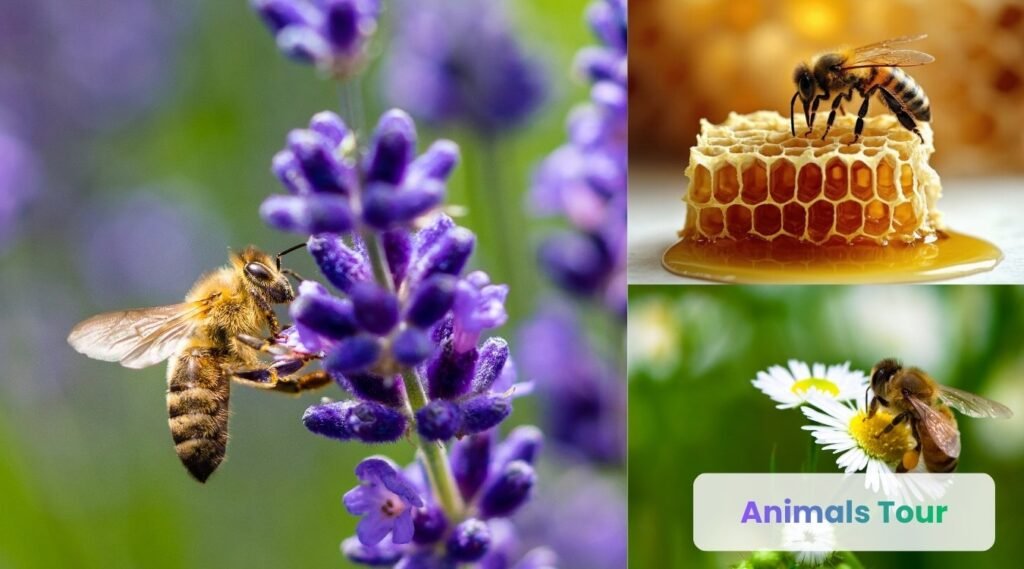
When a colony needs a new home, scout bees search for possible nesting sites and return to promote them through their dances. Better locations receive longer and more energetic dances. Over time, the colony chooses the best option through collective decision-making rather than following a single leader.
Ant – Expert in Teamwork and Collective Intelligence
Scientific Name: Formicidae (family)
Diet: Omnivorous
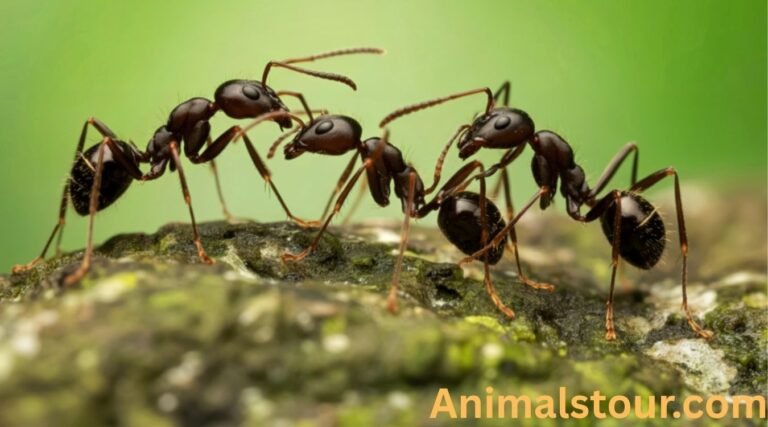
Ants have existed for more than 100 million years and are found almost everywhere on Earth except Antarctica. Known for their organization, adaptability, and teamwork, ants live in colonies where different groups handle tasks such as gathering food, defending the nest, and caring for young ants. These abilities are one reason ants are considered among the smartest insects in the world.
Some ant species can also teach and share information. In a species known as rock ants, experienced ants guide younger ants to food sources through a process called tandem running. The leading ant slows down and waits if the younger ant falls behind, making it one of the clearest examples of teaching behavior in insects. Ants also communicate using chemical trails called pheromones, which help colony members locate food and quickly switch to shorter or safer routes when needed.
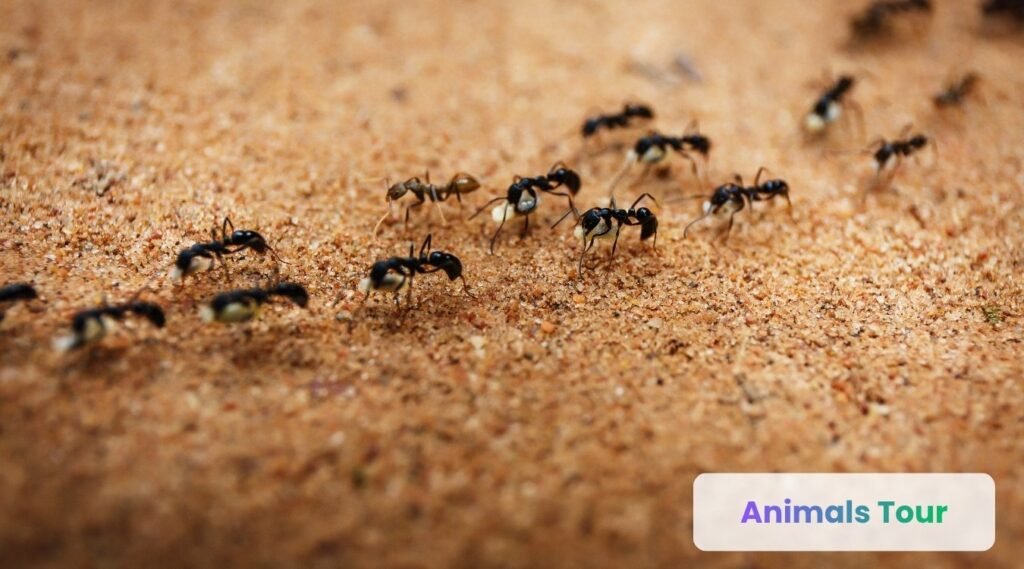
Ant colonies make group decisions through a process known as quorum sensing. When scout ants search for a new nest site, enough ants must inspect and approve a location before the colony moves. No single ant controls the decision. Instead, the colony reaches a conclusion collectively through communication and numbers. This system of cooperation and problem-solving shows a level of efficiency rarely seen in such small animals.
Cockroach – Highly Adaptable Survivor
Scientific Name: Periplaneta americana (American cockroach) (common example species)
Diet: Omnivorous
Cockroaches have existed for around 300 million years and survived major environmental changes that wiped out many other species. Their ability to adapt quickly is one reason they are considered among the smartest insects in the world. Found in forests, cities, and deserts, cockroaches can survive for weeks without food and adjust their behavior based on their surroundings.
Studies show that cockroaches can learn from experience and remember information. In lab experiments, they learned to connect certain smells with food rewards and remembered those associations over time. They also communicate using chemical signals and can copy the behavior of other cockroaches, such as avoiding unsafe areas. Their internal body clock helps them stay active during safer times of the day.
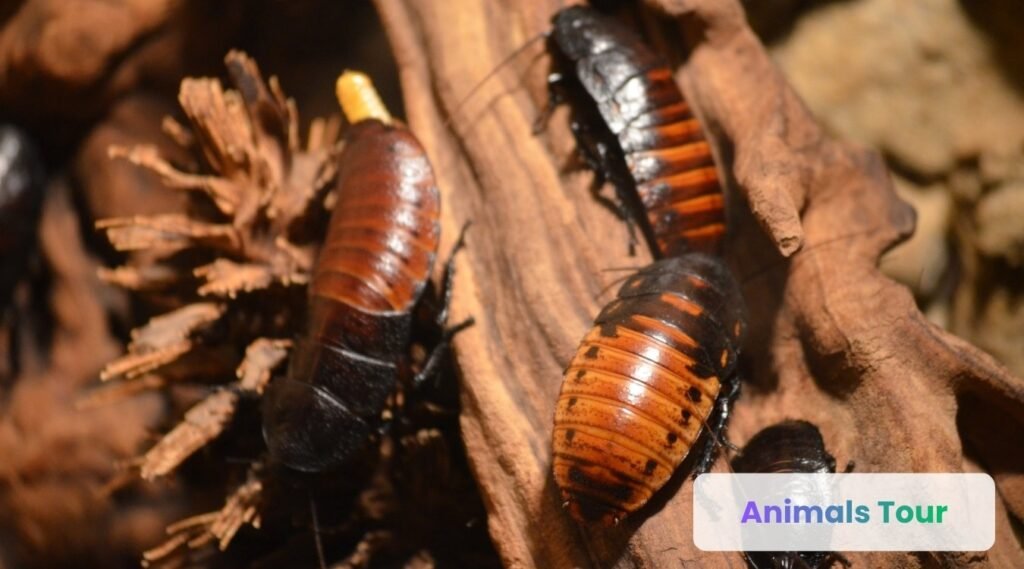
Cockroaches also adapted to human pest control methods. In the 1980s and 1990s, many baits used glucose because cockroaches were attracted to sweet substances. Over several generations, some populations developed a dislike for glucose and began avoiding the bait. This fast behavioral change helped them continue surviving in environments designed to eliminate them.
Dragonfly – Precision Hunter With Fast Processing Skills
Scientific Name: Anisoptera (suborder)
Diet: Carnivorous – mainly eats mosquitoes, flies, midges, and other small flying insects
Dragonflies are some of the oldest flying insects on Earth. They were around before dinosaurs existed. Today they are known as some of the most effective hunters in the animal kingdom. They catch over 95 percent of the prey they go after. For comparison, lions succeed on about one in four attempts. This high success rate comes down to how dragonflies process information while flying and how they plan their attacks.
Dragonflies do not just chase prey. They predict where the prey is going to be and fly to that spot directly. This is called interception hunting and it requires the dragonfly to calculate the future position of a moving target, which involves real time processing of speed, direction, and distance. Their eyes cover almost 360 degrees, but they can also lock onto a single target inside a swarm of insects and filter everything else out. This kind of focused attention is something very few animals can do.
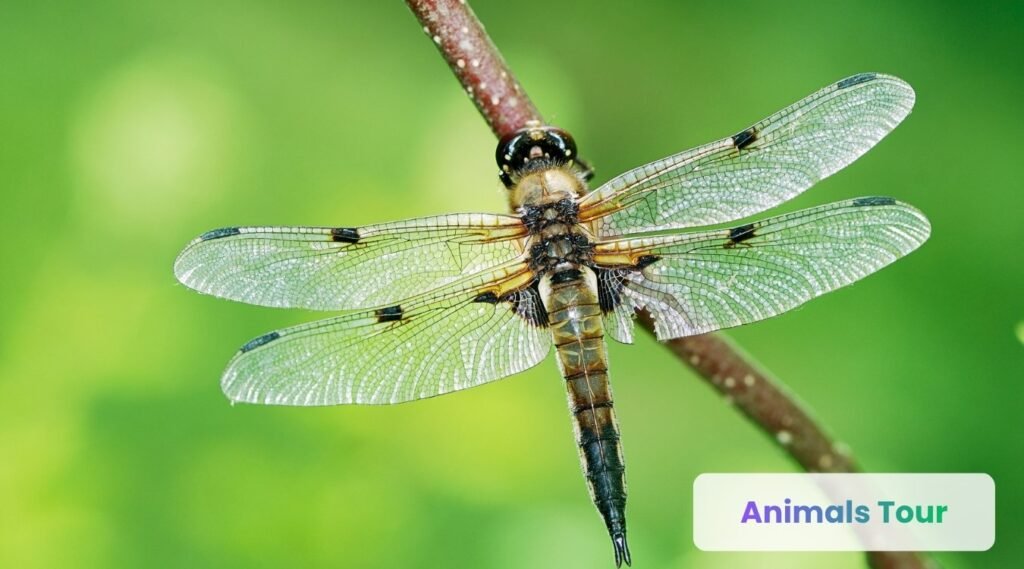
Dragonflies also have good spatial memory. They patrol specific territories, return to preferred resting spots, and keep track of which areas have produced food before. Their flight is not random. They make decisions about where to go based on what has worked previously. For an insect without a large brain, the level of processing that goes into every dragonfly hunt puts it firmly among the smartest insects.
Wasp-Insect With Advanced Face Recognition
Scientific Name: Polistes (paper wasps, example genus)
Diet: Omnivorous
Most people know wasps as aggressive insects, but paper wasps from the *Polistes* group show advanced social behavior and memory. Unlike bees or ants, their colonies do not have a fixed hierarchy, so wasps must recognize and remember other colony members to understand social rank. This is one reason they are considered among the smartest insects in the world.
Scientists discovered that paper wasps can recognize individual faces. Studies showed they responded specifically to facial patterns rather than random markings, helping them identify familiar wasps and maintain social order within the colony.
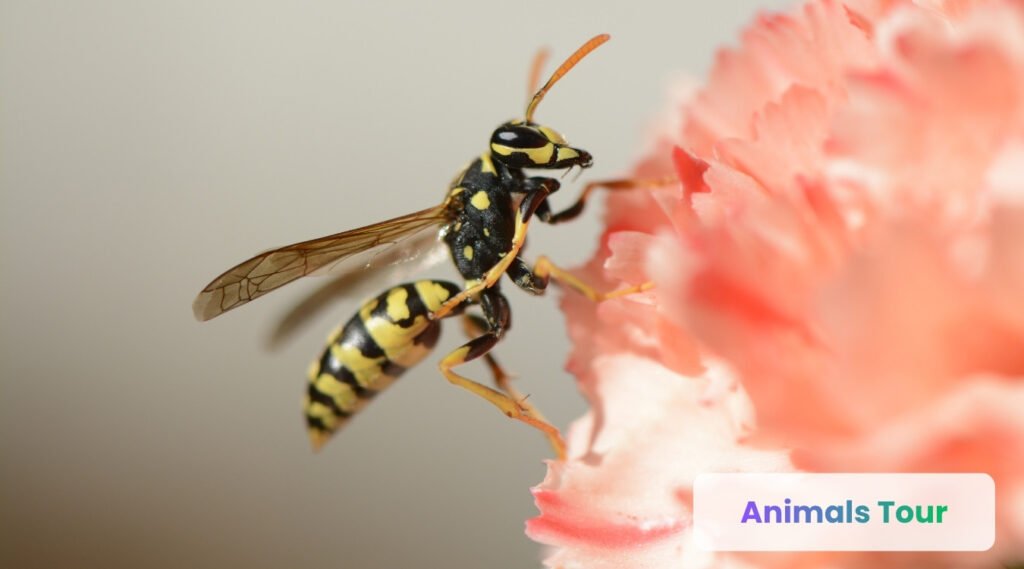
Wasps are also skilled hunters that learn from experience. If a hunting attempt fails, they may change their strategy the next time. They build paper-like nests using chewed wood fibers and adjust the nest structure depending on the surface where it is attached. Their ability to learn, adapt, and solve problems is what makes them stand out as one of the smart insects on this list.
Housefly – Fast-Thinking Flying Insect
Scientific Name: Musca domestica
Diet: Omnivorous – feeds on decaying organic matter, rotting food, garbage
Houseflies may seem simple, but they have surprisingly advanced reflexes and learning abilities. They process visual information far faster than humans, allowing them to detect danger and escape before a swatting hand can reach them. Their quick reactions come from an extremely efficient nervous system.
Studies show that houseflies can learn and remember routes in maze experiments, especially when rewards are involved. They use landmarks to return to food sources and change their behavior based on past experiences. They also show habituation, meaning they gradually stop reacting to harmless repeated stimuli.
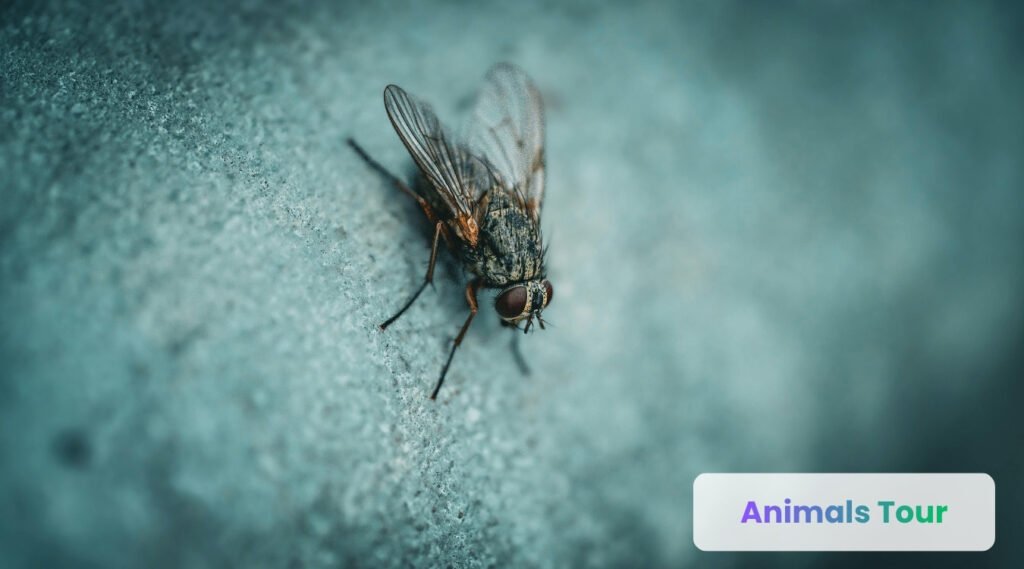
Houseflies even sleep, and lack of sleep reduces their learning ability and reaction speed. Despite their tiny brains and short lifespan, their fast processing, memory, and adaptability make them one of the smartest insects in terms of neurological efficiency.
Bumblebee – Problem Solver With Learning Ability
Scientific Name: Bombus (genus)
Diet: Nectar and pollen from flowers
Bumblebees are larger, rounder relatives of honey bees, but their colonies are much smaller, usually only a few hundred bees. Unlike honey bees, they do not rely on highly complex communication systems, which once made them seem less intelligent. However, research has shown that bumblebees are capable of learning, problem-solving, and flexible decision-making, which is why they are considered among the smartest insects in the world.
In experiments, bumblebees learned to solve tasks such as moving objects to reach a sugar reward. After watching other bees, they could repeat the behavior, but many also developed their own methods instead of copying exactly. This shows they are capable of comparing options and choosing strategies that work best for them.
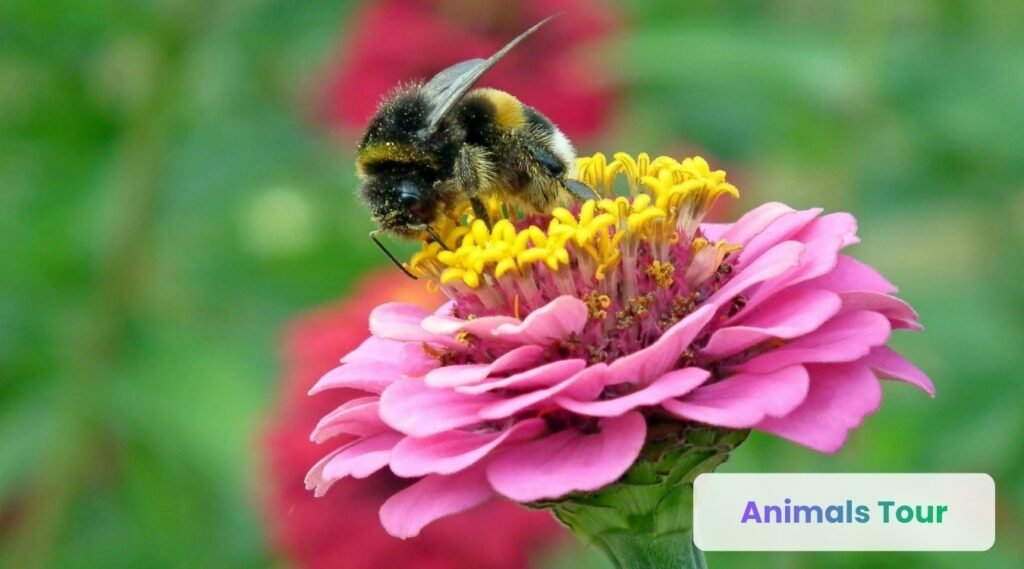
Bumblebees have also shown behavior linked to play. Young bees have been observed rolling small objects even when there is no reward involved. This suggests they explore and interact with their environment beyond what is necessary for survival, showing a level of behavioral flexibility uncommon in insects.
Dung Beetle – Navigator Guided by the Milky Way
Scientific Name: Scarabaeinae (subfamily)
Diet: Feeds mainly on animal dung
Dung beetles feed on and reproduce in animal waste, which may seem unimpressive at first glance. However, they have one of the most unusual navigation abilities in the insect world: they can use the Milky Way to orient themselves. At night, dung beetles roll their dung balls in straight lines across open ground to move away quickly and avoid having them stolen by other beetles.
Research has shown that they rely on the night sky for direction. In experiments, small caps placed over their heads blocked their view of the sky, causing them to lose their straight path and move in circles instead. When the caps were removed, they returned to moving in straight lines. During the day, they navigate using the sun and patterns of polarized light. In both cases, they use visual cues from the environment to maintain direction over long distances.
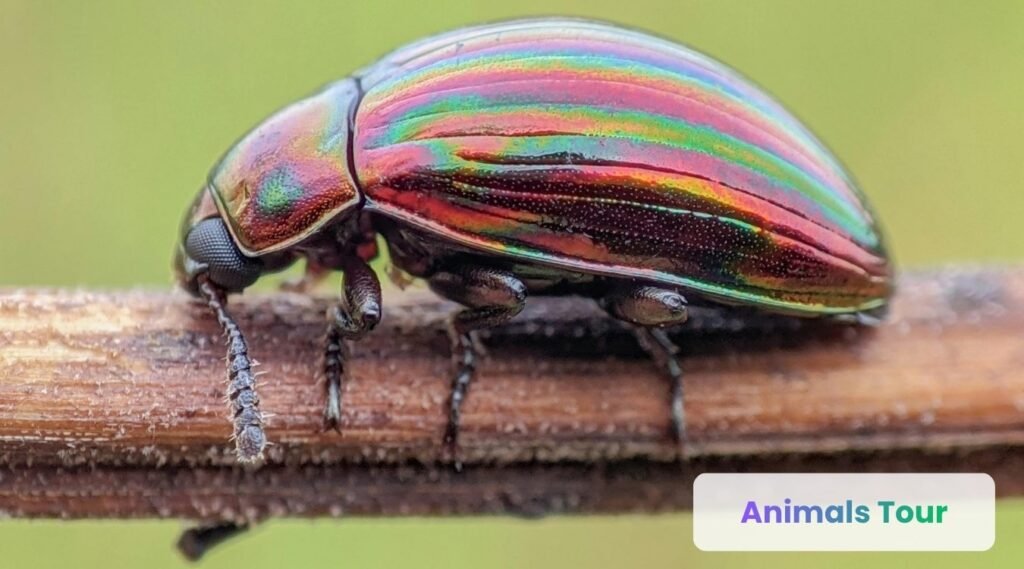
Unlike many social insects, dung beetles do not build complex colonies or communicate extensively. Their intelligence is highly specialized and focused on navigation. This ability to use celestial cues, including the Milky Way, places them among the more capable navigators in insects.
Monarch Butterfly-Long-Distance Navigation Expert
Scientific Name: Danaus plexippus
Diet: Caterpillars feed on milkweed leaves; adults feed on nectar from flowers
Every year, monarch butterflies travel up to 4,500 kilometers from Canada and the northern United States to forests in central Mexico. What makes this journey unusual is that the butterflies making the trip have never been there before. The previous generation has already died, yet each new generation still finds the same destination without guidance. This natural navigation ability is one reason monarch butterflies are considered among the smartest insects in the world.
Monarchs use the position of the sun to determine direction and adjust for the time of day using an internal clock located in their antennae. Studies have shown that if the antennae are damaged, their navigation becomes disrupted. They also appear to use the Earth’s magnetic field as a backup navigation system when sunlight is limited. During migration, monarch butterflies even change their feeding behavior to build fat reserves for the journey.
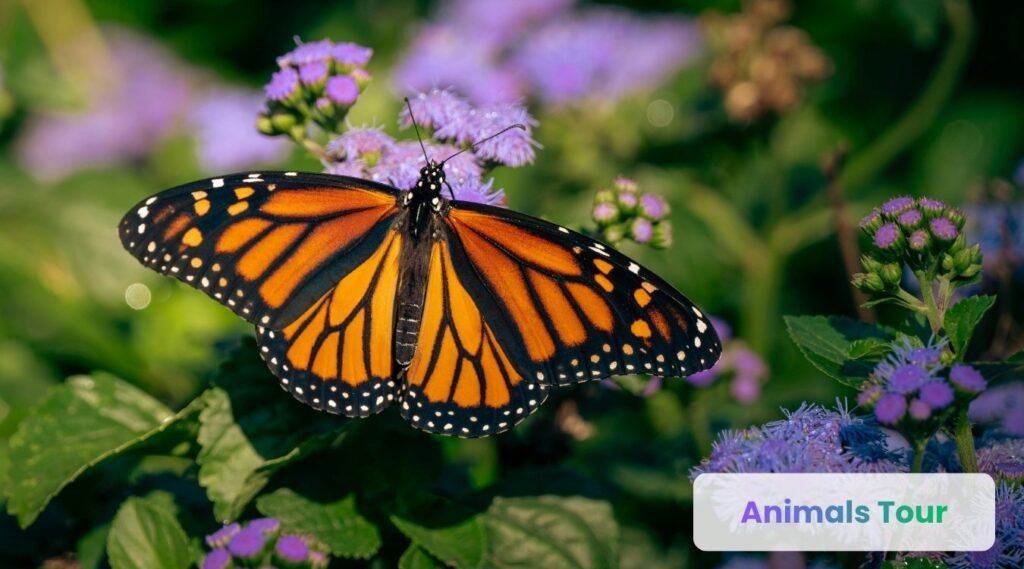
The monarch butterfly does not learn its migration route because the information is encoded in its biology before it hatches. However, it still makes real time adjustments during the journey by correcting for wind, choosing when to rest, and selecting suitable food sources. This combination of built in knowledge and active decision making is what places the monarch butterfly among the top smartest insects in the world.
Praying Mantis-Predator With 3D Vision
Scientific Name: Mantodea (order)
Diet: Carnivorous – feeds on flies, moths, crickets, and other small insects
The praying mantis is a predatory insect found in warm regions around the world and is known for its precise hunting skills. It waits motionless for prey to come close before striking with its front legs at extremely high speed. One reason the praying mantis is considered among the smartest insects in the world is its ability to judge distance accurately before attacking.
The praying mantis is the only known insect with true three dimensional vision. Instead of relying only on movement, it processes the difference between what each eye sees to calculate depth and distance. Scientists confirmed this in studies where mantises wearing tiny 3D glasses correctly struck at 3D images of prey, proving they use stereo vision similar to humans and some other animals.
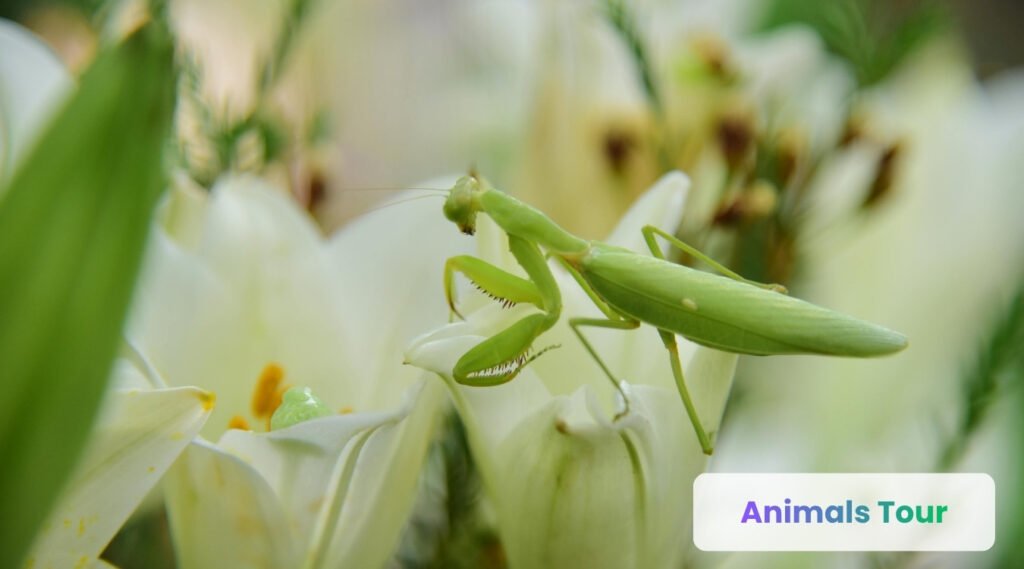
Mantises also adjust their hunting behavior depending on the prey in front of them. Larger or more dangerous prey may trigger a different response than smaller targets. Some species even sway their bodies along with moving plants or grass to stay hidden, showing active camouflage and constant awareness of their surroundings.
Leafcutter Ant – Insect That Developed Farming
Scientific Name: Atta and Acromyrmex (genera)
Diet: Does not eat leaves directly – feeds on fungus grown using cut leaf material
Leafcutter ants cut pieces of leaves and carry them back to their underground nests, but they do not eat the leaves directly. Instead, they use the leaf material to grow a specific type of fungus, which the colony feeds on. This means leafcutter ants have practiced farming for around 50 million years, making them one of the few animals known to develop agriculture.
Their farming system is highly organized. Leafcutter ants select specific plants and avoid ones that contain chemicals harmful to their fungal crop. They remove weeds and competing fungi from the garden and use natural antibiotics produced by bacteria on their bodies to help prevent infections. Some colonies even create separate waste disposal areas deep inside the nest to protect the food supply.
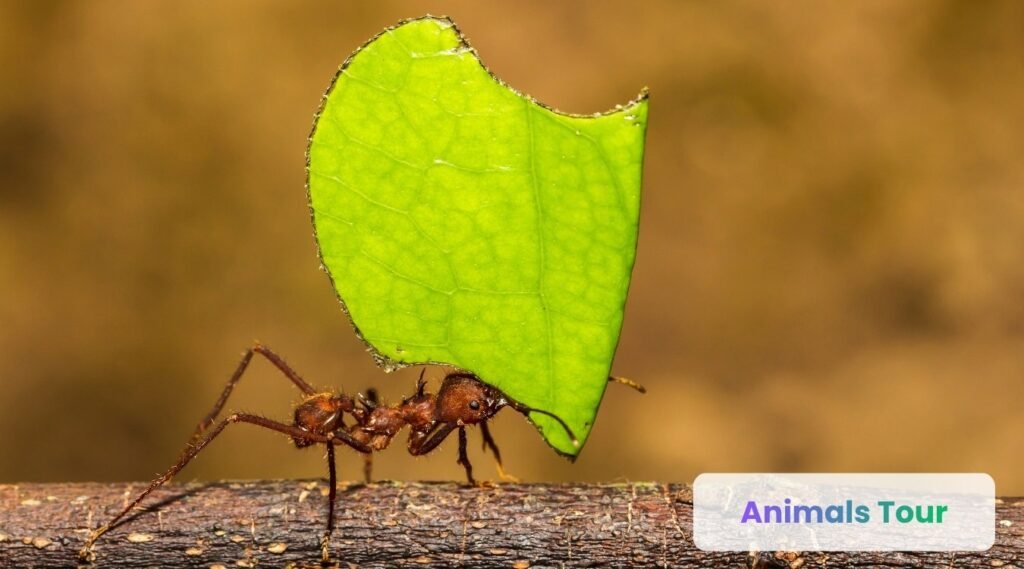
Leafcutter ants also adjust how they cut leaves depending on the plant type. Tougher leaves require different cutting angles, and foragers learn which plants produce the best results for their fungus gardens. The trails used to carry leaf material are maintained by worker ants, while chemical signals on the trails are constantly updated as conditions change. These behaviors make the leafcutter ant one of the most advanced and organized insects known to science.
Firefly – Insect With Precise Light Communication
Scientific Name: Family Lampyridae (contains many species such as Photinus pyralis)
Diet: Nectar and plant fluids as adults; larvae are carnivorous and feed on small insects
Fireflies produce light through a chemical reaction inside their bodies and use it to communicate. Different species have distinct flashing patterns, and males and females exchange signals to find each other. The timing has to be precise, with some species flashing at intervals accurate to within milliseconds, making coordination in flight and darkness highly demanding for such small insects.
Some female fireflies use deceptive hunting strategies. In certain predatory species, females mimic the flash patterns of other fireflies to attract males looking for a mate. When the male approaches, the female captures and eats him. This requires recognizing and switching between different flash patterns depending on the situation.
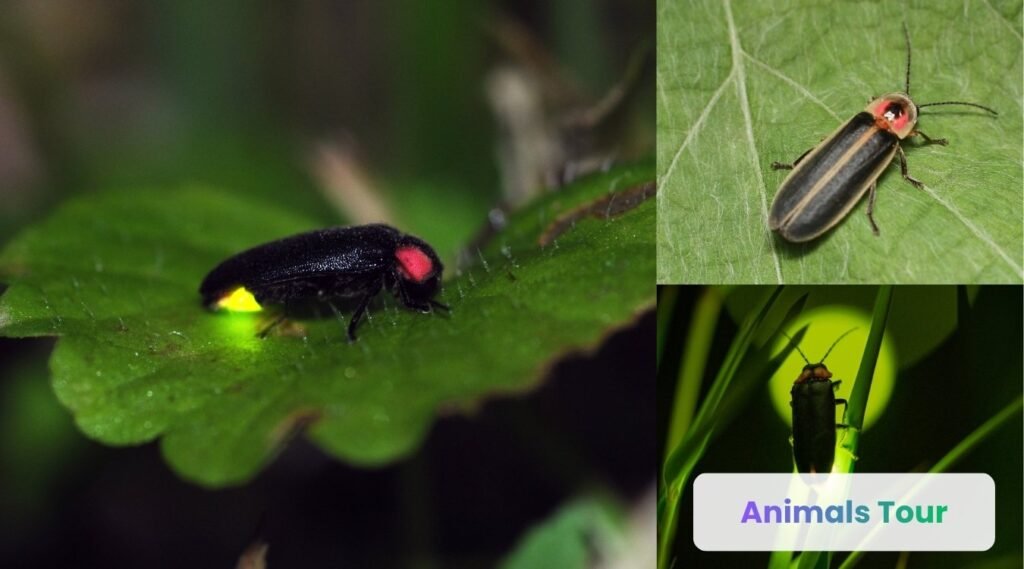
In some regions, large groups of fireflies synchronize their flashing so that entire trees appear to pulse with light. Each firefly adjusts its timing by responding to nearby flashes, allowing the group to coordinate without any leader. This self-organized behavior is an example of collective insect intelligence.
Conclusion
The insects in this list show that intelligence is not limited to large brains or one type of thinking. The top 12 smartest insects in the world use different skills like communication, hunting, navigation, and migration. Together, they show that insect intelligence is real and varied, with learning, memory, adaptation, and even deception helping them survive for millions of years.
FAQs
What is the smartest insect in the world?
The honeybee is often considered the smartest insect due to its complex social structure, problem-solving abilities, and communication through elaborate dances.
How do insects show intelligence?
Insects display intelligence through behaviors like problem-solving, social organization, navigation skills, and the ability to learn from experience.
What are smart bugs? Give examples
Smart bugs are insects or arthropods that exhibit advanced behaviors, utilizing problem-solving skills, social interactions, and environmental adaptations to thrive.
Examples include honeybees, which communicate through dance; ants, known for their teamwork; and certain spiders that display strategic hunting techniques
What are the most intelligent insects?
Ants, honeybees, and certain species of cockroaches are often cited as among the most intelligent insects.